Understand first, model second.
I spend the first days not in code but in conversations. With the people who'll actually use the system. The best prompt in the world is useless if the question behind it is wrong.
→ Interviews, not briefings
I'm Mark — PhD in Cognitive Systems, software engineer, sometimes university lecturer. I translate between subject matter and engineering, between research consortia and startups. My craft is making AI understandable — without softening it.
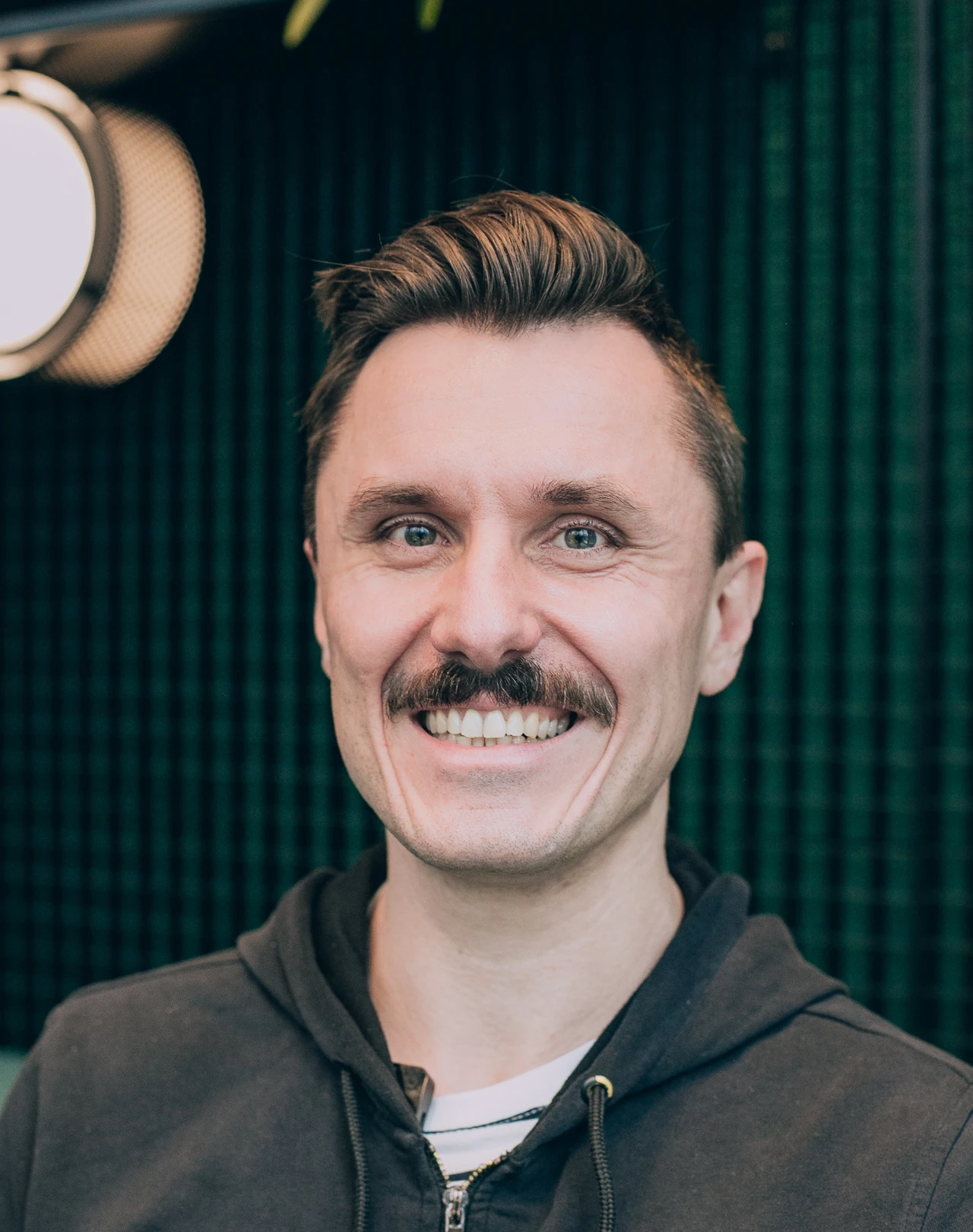
Half researcher, half engineer. I come out of foundational work — symbol grounding, consciousness, the weirder corners of cognition — and I've spent fifteen years building ML systems where correctness touches lives, newsrooms, or classrooms.
PhD at the Otto-Friedrich-Universität Bamberg on symbol grounding — on how artificial systems develop meaning. Awarded the Springer Best Paper at the 11th AGI Conference in Prague (2018). Since then: Key AI Architect at University Hospital Leipzig (AMPEL), Research Associate at FAU Erlangen-Nürnberg, and Lead AI Developer for The Bina School.
The practice swings between two poles: foundational inquiry into how meaning forms in artificial systems — and the concrete building of ML systems in places where correctness counts: clinical labs, editorial newsrooms, classroom software.
I spend the first days not in code but in conversations. With the people who'll actually use the system. The best prompt in the world is useless if the question behind it is wrong.
If AI is the wrong tool for your problem, I'll say so. Sometimes it's a database. Sometimes a form. Sometimes a hard decision no model can take for you. I don't sell what doesn't fit.
Success means you don't need me any more. Every project ends with documentation, handover workshops, and a team that understands the code and can keep building. No lock-in, no retainer trap.
LLMSecTest: open-source test suite covering the OWASP LLM Top 10. Pytest plugin with SARIF output, CI/CD templates, 100+ red-team prompts. Six-month funding with a second-stage extension applied for.
Leading AI development on the Precision Education platform: adaptive learning paths, real-time progress tracking, personalised curricula for ages 4 – 12.
DoppelCheck named a finalist at the 4D Digital Rights by Design 2024 Award for browser-based tooling against disinformation.
Developed SpotTheBot and DoppelCheck — AI tools for detecting disinformation and AI-generated text, with support from the BMBF and the WPK Innovation Fund.
Machine learning for shallow geothermal systems: predictive modelling and optimisation, including peer-reviewed work on thermal-conductivity prediction.
AI coach to support small and medium-sized businesses. Involved in the MediBot and Demonstrator "Elektronische Rechnungslegung" projects.
Architect of a Clinical Decision Support System, deployed across 1,500+ hospital beds. Co-first author of the primary AMPEL publication in JMIR Medical Informatics (2021).
Award for the dissertation work on symbol grounding. Published in Springer Lecture Notes in Artificial Intelligence.
Machine learning for procurement analytics: automated data extraction, AI-driven spend categorisation, predictive analytics.
Competitive doctoral fellowship for research on symbol grounding and cognitive systems.
Clinical documentation, rare diseases, guideline search. Experience with GDPR & MDR.
Administrative processes, citizen dialogue, parliamentary documents. On-prem & sovereign-cloud setups.
Quality assurance, service knowledge, tender assistance. Focus on integrable solutions, not replacement.
Grant proposals, consortium projects, scientific evaluation. BMBF, Horizon Europe, Interreg.
— What's not on the list: what I don't know, I say. —
Wernsdorfer, M. et al. — "AMPEL: A Clinical Decision Support System for Real-Time Patient Monitoring."
JMIR Medical Informatics, co-first author. Read the paper →
Wernsdorfer, M. — "How Failure Facilitates Success: Symbol Grounding Revisited."
11th AGI Conference, Prague · Springer Best Paper Award.
Symbol Grounding — Foundations of conceptual understanding in artificial systems.
Otto-Friedrich-Universität Bamberg. Read the thesis →
"A geiger counter in hand, or the reactor under control?" — why LLM security belongs in the application, not in its users' media literacy. Drawn from LLMSecTest's runs against some 50 LLM-backed applications.
Prototype Fund blog (in German). Read the post →
Peer-reviewed work on ML-based modelling of thermal conductivity in shallow geothermal systems (KNW-Opt, META study). FAU CRIS profile →
"Teach people, not machines" — on SpotTheBot, and how to pass on detection knowledge without training the next model generation on it.
Prototype Fund blog (in German). Read the post →
DoppelCheck & SpotTheBot — open-source tools for detecting disinformation and AI-generated text. GitHub profile →
ARTeFact (Spiegelbox) — interactive AI installation at Globe Theatre Leipzig, on the ethical dimensions of AI empathy.
§ 06 — Let's talk
I keep 2 – 3 first-call slots open per week. 30 minutes, no obligation, in German or English. The outcome: an honest read on whether I can help — and if so, how.